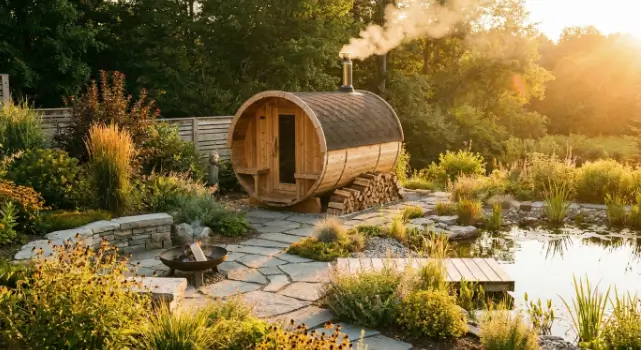
A barrel sauna installation has three requirements that determine whether the project goes smoothly: a level, well-draining foundation under the cradle, a dedicated 240V electrical circuit run by a licensed electrician for most heaters above 6 kilowatts, and clearances of at least 3 feet on the sides and back plus room for the door to swing open. Skipping any one of these tends to surface as a problem within the first year, either as standing water rotting the base staves or a breaker that trips every time the heater cycles.
What Foundation Does a Barrel Sauna Actually Need?
A barrel sauna sits on a cradle, a curved skid base, and that cradle needs a flat, well-draining surface rather than a poured concrete slab. A gravel pad, a paver base, or a properly rated existing deck all work. The critical detail is grading: the site should slope slightly away from the cradle so rainwater does not pool underneath it, since standing water under the base staves is the single most common cause of premature rot in an otherwise well-built barrel. Compact the gravel or paver base thoroughly before setting the cradle, and check level in both directions, since an uneven cradle stresses the hoops that hold the curved staves together.
What Electrical Work Does the Heater Require?
Most barrel sauna heaters between 6 and 9 kilowatts need a dedicated 240V circuit, which is a different requirement than the 120V plug-in setup common on smaller infrared cabins. Running that circuit from the panel to an outdoor barrel location is licensed electrician work in nearly every jurisdiction, both for safety and because unpermitted outdoor electrical work is a real problem if the home is ever sold and inspected. Expect the electrician to install a disconnect switch within sight of the heater, a common code requirement for outdoor electrical equipment, along with weatherproof conduit protecting the wire run from the house to the barrel.
Distance from the electrical panel is the biggest cost driver here. A barrel placed close to the house with an accessible panel might see a circuit run cost of $500 to $800, while a barrel at the far end of a large yard can push that number to $1,500 or more once trenching and conduit are factored in.
What Clearances Does Placement Need to Respect?
Beyond the barrel’s own footprint, most manufacturers recommend at least 3 feet of clearance on the sides and back for airflow around the wood and for maintenance access to check the tension hoops periodically. The door side needs more room, typically 3 to 4 feet, for the door to swing fully open and for comfortable entry and exit. Overhead clearance matters too if the barrel sits near trees, since falling branches or heavy leaf litter on the curved roof can trap moisture against the wood if not cleared regularly.
Setback from property lines and structures is a separate question from manufacturer clearance recommendations, and it is governed by local zoning rather than the sauna maker. Many municipalities treat a barrel sauna like a shed or accessory structure for setback purposes, often requiring 3 to 5 feet from a property line, though this varies enough by location that checking with the local building department before finalizing placement is worth the phone call.
Does the Barrel Itself Need a Permit?
This is genuinely inconsistent across jurisdictions. Some treat a barrel sauna as a movable accessory structure similar to a large shed and require no permit for the barrel itself, while others classify anything with a permanent electrical hookup as requiring a building permit regardless of whether the structure is bolted down. What is far more consistent is that the electrical work itself, the 240V circuit and disconnect switch, typically requires a permit and inspection on its own, separate from any structural permit question. Starting with a call to the local building department before ordering the barrel avoids a scenario where the sauna is fully assembled and wired before anyone learns a permit was required.
What Does the Full Installation Timeline Look Like?
From groundbreaking to first use, a complete installation typically takes one to two weeks, assuming no permit delays hold up the electrical work. Site prep and foundation curing, if using a poured paver base rather than compacted gravel, usually takes the longest single stretch, several days to a week. Barrel delivery and assembly, once the site is ready, is typically a one- or two-day job for a crew or a motivated homeowner with help. Electrical hookup, if scheduled in parallel with site prep rather than after, often adds no extra time to the overall timeline since the electrician can run the circuit while the foundation cures.
Does the Health Research Change How Installation Priorities Should Be Set?
A review in Mayo Clinic Proceedings on the cardiovascular and other health associations of sauna bathing found the strongest associations among people using a sauna several times a week, and an older review in The American Journal of Medicine on the benefits and risks of sauna bathing describes similar patterns tied to frequency of exposure. Most of this research is built on traditional Finnish-style dry sauna generally, not barrel construction specifically, and describes population-level association rather than a guarantee for any individual household. It is still a reasonable argument for treating the electrical and foundation work as the parts of the project worth getting right the first time, since a household planning to use the barrel several times a week will put real cycling stress on the heater and real weather exposure on the base staves over a normal year.
Where to See Full Model Specs Before Ordering
Foundation and electrical planning both depend on knowing the exact heater wattage and cradle dimensions of the model being ordered, which varies between makers even at the same nominal diameter. Checking SweatDecks’ lineup for stated heater kilowattage and cradle footprint before scheduling an electrician or pouring a pad avoids having to redo groundwork after the barrel arrives with different specs than assumed.
Frequently Asked Questions
Can I install a barrel sauna heater myself? Setting the heater and connecting pre-wired stones is usually straightforward, but the 240V circuit should go to a licensed electrician in almost every jurisdiction. Unlicensed wiring can void the warranty and create a safety risk.
How far does a barrel sauna need to sit from a fence or property line? Setback requirements vary by municipality, often 3 to 5 feet from a property line, similar to a shed. Check local zoning before finalizing placement.
Does a barrel sauna need a building permit? This depends on local code and whether it is considered permanent or movable. A hardwired circuit typically requires a permit regardless, so check with the building department first.
How long does a full barrel sauna installation take? Site prep, delivery, assembly, and electrical hookup together typically take one to two weeks, assuming no permit delays. Assembly itself is usually a one- or two-day job.
References
- Cardiovascular and Other Health Benefits of Sauna Bathing: A Review of the Evidence, Mayo Clinic Proceedings, 2018
- Benefits and risks of sauna bathing, The American Journal of Medicine, 2001
- Effects of heat and cold on health, with special reference to Finnish sauna bathing, American Journal of Physiology – Regulatory, Integrative and Comparative Physiology, 2018
By Nadia Ferris